
The In-Between
The doorway to ...

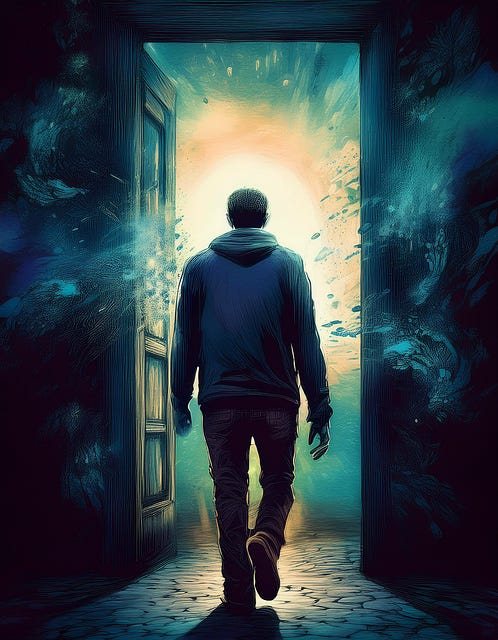
Within spiritual exploration there’s a place that isn’t quite “before” and isn’t quite “after.” It’s the threshold itself. The in-between. The place where the old shape of your life no longer fits, and the new shape hasn’t fully arrived.
That threshold is what many traditions call the liminal, from limen, meaning “doorway.” And doorways are never neutral. A doorway is a passage, a choice, an opening. It’s where familiar rules loosen, certainty thins out, and something deeper can finally get through.
In plain terms, liminal space is the space between two distinct phases. It can feel like ambiguity, disorientation, and being “betwixt and between.” But spiritually, the liminal is often where the most honest transformation happens, because you can’t rely on your old scripts there. You can’t posture your way through a threshold. You have to listen.
And here’s what I’ve learned: the liminal isn’t merely a concept. It’s a field in consciousness, a sacred inner climate where your identity becomes more fluid, your perceptions expand, and the illusion of separation begins to dissolve. The liminal is where the soul stops performing who it used to be, and starts remembering what it is.
Many spiritual paths have language for this between-worlds reality. In earth-based traditions and in certain streams of witchcraft, liminality is honored as a mystical state where the veil is thin, where the edges of reality soften and communion becomes more accessible. Thresholds matter: doorways, crossroads, shorelines, forests where light shifts, places where elements meet. These are considered sacred not because they’re spooky, but because they are symbolic: they reflect what’s true in consciousness. When two worlds touch, new possibility is born.
That’s also why liminal timing is revered. Dawn and dusk. Seasonal turning points. Moon phases. Transitional moments. These are metaphors made physical. They remind us the universe itself is always moving through thresholds, and there are times when the world seems to whisper, Come closer.
Liminality also appears in rites of passage, initiation, ending, beginning, grief, birth, divorce, healing, deconstruction, awakening. These are not merely life events. They are crossings. They ask something of us. They strip away what was held together by routine and certainty, and they reveal what was held together by Spirit.
The phrase “betwixt and between” is often used to describe this state, and I love it, because it tells the truth: in liminal seasons you are neither who you were nor who you’re becoming. You’re in the sacred middle. You’re being re-formed.
And yes, that can be uncomfortable. The mind hates not knowing. The ego wants a label, a plan, a guarantee. But the soul understands something the mind forgets: the liminal is not a mistake. It is a method. The threshold is one of Spirit’s favorite classrooms.
This is why the liminal invites us to dance with uncertainty instead of treating it like a problem to solve. Our culture rewards clarity, categories, fixed identities. But the Divine often moves by unfixing us, loosening the tight definitions we’ve clung to for safety. Not to destabilize us for cruelty, but to liberate us into a wider truth.
In the liminal, identity becomes less like a statue and more like a river. You begin to sense how much of who you’ve called “me” was formed by expectation, conditioning, survival strategies, religious fear, or the need to be approved. And as those layers begin to shed, something more authentic rises, not manufactured, not forced, but revealed.
This is where the Divine feels intensely intimate. Not because the liminal is magical in a theatrical way, but because it quiets what is noisy. It thins what is crowded. It makes room. When you’re no longer clinging to an old world, you become more available to the Presence that has been reaching for you all along.
And liminal space isn’t only mystical. It’s also literal.
In our everyday landscape, physical liminal spaces live everywhere, quietly waiting to be noticed. Alleyways, abandoned buildings, stairwells, train platforms, parking garages, corridors, doorways. Places designed for passing through, not staying. And yet those very spaces carry a strange energy: they are built on transition. They feel like thresholds because they are thresholds.
Even times of day can be liminal. Dawn and dusk don’t just change the light, they change the psyche. Shadows stretch. Edges blur. The world becomes softer, more porous. And we remember: there are realities we’ve trained ourselves not to see.
In a world that chases certainty, the liminal offers a different wisdom: become a friend of the threshold. Let it work you. Let it teach you. Let it empty what needs to be emptied and open what needs to be opened.
Because spiritual growth doesn’t only happen when everything is stable and clear.
Spiritual growth often happens when you can’t see the whole road. It happens in the doorway, in the in-between. It happens in The Liminal, where transformation is not efforted… but allowed.